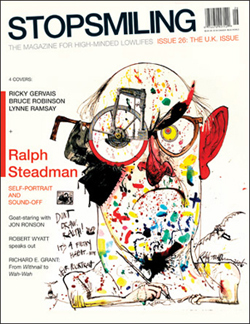
The following piece originally appeared in The U.K. Issue. Presented here is the unabridged, 5,700-word Q&A.
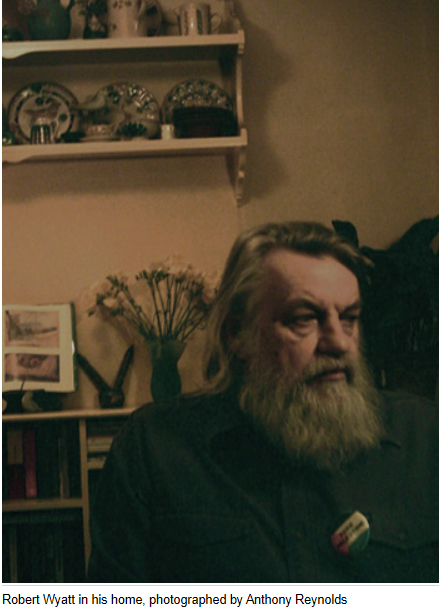
I arrive around five. Being England in January it’s dark and raining. The house is fronted by black railings to which bicycles are chained. There are two gates. I ring the bell and Robert Wyatt appears. We shake hands and he leads me into the warm, low-lit front room that has the feeling of a well-heeled bedsit. It’s tidy but lived in, with a hotplate beside a baby grand piano. There is a basic recording setup in the corner: a microphone, small mixing desk, a keyboard and various percussion instruments. On the wall is a Basquiat and smaller framed portraits are around the room.
Robert offers tea, but I pull two bottles of Bordeaux from my bag. He tells me to take a seat in the dining room while he finishes his business in the music room. Alone, I scan the bookshelves: Picasso, Beuys, Hockney.
Wyatt’s wife, Alfreda Benge, joins me. “Alfie” is also Wyatt’s professional collaborator, providing occasional lyrics and record art. She has just written lyrics for four tracks of Parisian DJ Bertrand Burgalat’s most recent album, Portrait Robot. It’s her first writing gig for someone other than her husband. As Alfie disappears into the back of the house, I am joined by Robert, who decides to take up smoking again. (He had given up three days previously.)
Wyatt was a founding member of the Soft Machine, (named after the William S. Burroughs book, although he no longer recalls why). Along with Pink Floyd, the group transformed the late ’60s psychedelic scene of the U.K. into a new and valid form of musical expression. They soon evolved into a jazz-rock fusion group, punctuated by Wyatt’s passionate, disciplined drumming and unique vocals. A substantial cult following bloomed across Europe. After countless sessions, extensive touring (including a 1971 trip to the States with the Jimi Hendrix Experience), Wyatt was sacked. He immediately assembled the improv fusion combo Matching Mole. (The name was a pun on machine mole, which is Soft Machine in French). They released two critically acclaimed LPs before splitting in 1972.
In 1973, after consuming considerable amounts of alcohol at a party in London, Wyatt fell from a third floor window, leaving him paralyzed from the waist down. After recuperating in the hospital for a year, Wyatt married Alfie and embarked on a solo career. He emerged as a vocalist with a singing style that was both refined and haunting. (Ryuichi Sakamoto has called Wyatt’s voice “the saddest sound in the world.”)
In 1997, a new audience was introduced to Wyatt with the release of a long-awaited album, titled Shleep. Though self-produced, Wyatt benefited from the participation of friends like Brian Eno, Paul Weller, Evan Parker and Phil Manzanera. Another critically acclaimed album, Cuckooland, was released in late 2003, preceding a collaboration with Björk on Medulla in 2004. Wyatt is presently recording his next solo album.
Stop Smiling: Tell me about getting older.
Robert Wyatt: Getting older gives you a long time to think. If you’re a slow thinker, you need that time. I was lucky with music. It’s a humble aspiration to find a way to make a living. When I was a child my parents used to get me to sing along with Christmas carols and I thought, I can hear the difference between this note and that note. It was a thrilling moment. Like when you learn to ride a bicycle. To me, that’s what all music is. I thank God for it, because it gave me a living. When people would say, “What motivates you? Did you want to be a rock star, a pop star, an artist?” I said, “I want to earn a fucking living.”
I can’t read music. I know the names of the notes. I know the wrong note from a right note, even on a fast bebop solo. I know music aurally, not orally. Listening to music is instinctive, enjoying it is instinctive. But as a writer I approach it as craftsmanship. I might have a drum part on tape for 10 years before I hear a bassline that will go with it. I don’t like to force tunes into existence before they are ready to come alive. They come out right if you wait for the tune. You can’t say, “I want a baby a month from now.” It takes time. But even then, the only reason I’m creative publicly is because we need the money. If I didn’t have to earn a living I would sit around listening to jazz records and never write a tune in my life. There are a lot of things the world is short of — for instance, enough fresh water for everyone to drink. But it’s not short of songs. I’m embarrassed about that, in a way. I could spend the rest of my life listening to music that already exists.
As far as I’m concerned about music, the last thing that really mattered to me, that could save my life, ended when John Coltrane died in 1967. But when I started, I was so bloody lucky the beat scene came along. The standards were so low that even someone who had no idea what they were doing could actually earn a living.
SS: Some would say, with your voice, that you’re gifted.
RW: I don’t know. When I open my mouth, I do the best I can. That’s all I can tell you. But compared to the people that inspire me, I know fuck all. And that’s not a choice. That’s why I wonder about the idea of free will.
I think it’s particularly hard for people brought up in the Western individualist tradition to accept the fact that ecstasy comes from losing yourself within something else. The simplest way you can do this is through sex — when you lose yourself in someone else. That contradicts the intellectual tradition of finding yourself. Instead, you surrender yourself and become a voice in the choir, where the choir is going on and you can’t even tell which voice is your voice and which voice is that of the person next to you. That to me is ecstasy. This isn’t something that’s available only to artists, although they may articulate it more expressly. But it’s the same thing that makes advertisers realize why they should do these kitsch little dreamscapes of some kind of pinky, bluey dreamy landscape that adverts are full of. To me it’s the only possible explanation as to why people yearn for the utter idiocy of religion, for example. It’s so tiring to carry the physical weight of your body.
This will probably be the last interview I’ll do as a 60 year old. I suppose I’m now entering the land of Old Man. It disappoints and frightens me that a lot of the things we thought we’d do never happened — I mean, you never expected to win the war. But we thought we’d win a few little battles along the way. Against racism, for instance. And we haven’t really because it just gets transferred to Arabs or immigrants, Gypsies or something or other. I mean, I understand it. I don’t expect a great deal from humans. The only thing I’m prepared to stand by are the actual lyrics and tunes of my songs. The only times I think, I’m going to hang this on the hook and leave it to dry, are when I actually write a song and put it on the washing line. I would defend any song I’ve written. If someone says, “Well, that’s an anachronism,” I think, “Good, because any song I’ve sung that is no longer necessary means there’s a battle that has in some way been won.” I’ve written songs about Nelson Mandela being in prison, which is where I assumed he’d spend his life. But I was wrong about that. I’m happy that song is an anachronism. Another song is “Born Again Cretin” [from the Nothing Can Stop Us album] which is about the blatantly idiotic Christian movement in North America. Which now, in fact, runs America. I was writing about the mindset that somehow means that if you’re attracted to Christianity, the people who represent it are basically arseholes. You think, “Well, if Jesus was such a nice man, did he need this kind of help?” [Laughs]
SS: Did you have a university education?
RW: No. People are quite shocked when they find out about the number of people I haven’t heard of — people who are terribly important to know about. There are a few people I’ve read who really helped me when I’ve felt I was getting intellectual claustrophobia. These people tend not to be artists at all. People like Noam Chomsky. I’m not very good at repertoire. It takes me ages to think through what anybody says, which is why I wouldn’t stick by anything that is said in a conversation of this nature. I react quickly, and I’m just as stupid as everybody else. I’ve found this magical area where if I’ve written 20 or 30 songs. Those songs, from the last 30 years or so, will certainly stand up. I’ll defend them. But I won’t defend all the bullshit I’ve talked in the middle.
SS: As an American voice, I suppose Chomsky is unique.
RW: Oh yes. There was a wonderful period, from the American Civil War, or even before that, from the war with the British Empire. That’s an interesting one — it’s the one that seems to be dead and buried. It’s neither dead nor buried, to the extent that Americans retain an extraordinary envy not of Britain as a democracy, but as an empire. They are more intrigued by our imperialist past than by our democratic modern era. Whenever they make films about the European past they always romanticize royalty over the mob.
Orson Welles’s The Magnificent Ambersons, for example. Even when they romanticize the [American] upper classes as evil, they are still considered much more interesting than the people they were oppressing. Even American intellectuals are quite unable, it seems to me, to transcend this crazy lust for imperial status, which you get from being Greek or Roman or British. People say, “Robert, everything you do is based on what happened on the American continent.” I don’t accept that there’s such a thing as the American people.
Speaking about this is so hard. I do it much better in songs. I get embarrassed by the differences between English culture and American culture when I’m trying to communicate with American intellectuals. The problem I have with intellectuals is that they start from a level of expectation so unutterably precious that it reminds me of the old French aristocracy. So, while seeming pluralistic, American culture has so far presented toward us a fake conflict between the squirearchy and the mob. They play this delightful game among themselves and it’s none of my business. They’ve got a democracy, they can vote for whom the hell they like and they can buy the books they like. But what I don’t like is when they apply this to everybody else.
There’s one great thing about me being as old as I am: I remember a wonderful thing that happened with the 20th century avant-garde. It blew the century off course, and I hope future centuries will be grateful. I sort of depend on the idea, intellectually, that they will be grateful, because something happened to European art when it transferred itself to America. It mixed with the rest of the world, particularly Africa. Constantin Brancusi was a sculptor from Eastern Europe. He was one of the late 19th century sculptors who set up the possibilities in his studios for the entire 20th century European art movement. He set up giant quasi-African sculptures and he turned the perception of the third world as a source of cheap materials, like oil and cotton, into a continent of peoples who had great imaginations. In the process of discovering and using these people, we have destroyed their imaginations. This gave me my political angle. And maybe it’s a given now, but the first person to whom this change of awareness occurred, so far as I know, was Brancusi. He started looking at these little artifacts that grave robbers and gold diggers had brought back from Africa.
The history of European art in relation to the third world is basically scalp-hunting. “Look at this nice pretty curved shape we have here. Turn it upside down and you have a little bowl.” What is it? Someone’s head. The history of scalping is that in fact, the Europeans in America basically used it. American soldiers were rewarded and praised for their conquest against the indigenous inhabitants. That is the origin of scalping. And then the American Indian picked up on that.
The most important thing in my life is the inspiration of black music in America. I was saying that this black music, which is dismissed as a kind of black underground, it’s the survival in the only way it knows how to survive, of the black culture which gave you the only valuable thing your civilization has come up with. So you can sit and snigger if you like but say thank you once in a while. I also have to like the tune. A piece of music can’t just be a bit of polemic for me. I can’t just make a speech and put music to it — that’s bollocks. I hate that. That’s why I don’t really like a lot of stuff that’s called folk music, just speeches set to music. Boring. I like music. Songs. Tunes.
Whenever critics put something down it’s because they don’t understand it. The only thing I would want to be noted for are the things I praised and loved and take no notice of things I hate — because they’re just things I don’t understand. And I’m burying myself here because I’m almost immediately discrediting everything I’ve just said. But I don’t care. I don’t have hubris. I stumble across occasional bits of beauty and truth. So if I describe myself as the quintessential anti-American, then I have to qualify that by saying, “Ah, but Chomsky, Charlie Parker, Thelonious Monk!” But then again, I don’t know the half of it. Like a lot of revolutionaries, I’m conservative in a hopeless way. I think that all the things I fought for have already been killed. So, I live in a strange twilight world. A ghostland.
SS: You sound quite alive on your records.
RW: It’s that Dylan Thomas thing: Go out whimpering or raging. I will go out fucking angry. All that beauty, all those different ways of living. Turning it into some kitsch shit, a cola-and-hamburger culture. How dare you? How fucking dare you!
SS: Yet you’ve covered many songs by American songwriters. Why?
RW: Many great Americans were anti-capitalist or involved with the left, like the lyricist of “Autumn Leaves,” Joseph Kosma. Or Yip Harburg, who wrote “Brother Can You Spare a Dime?” and “Over the Rainbow.” Or Abel Meeropol, who wrote the lyrics to “Strange Fruit.” Many of them had sympathy with the left. It’s amazing how many of the young American Jewish and Italian radicals in the ’30s were against capitalism. During the Depression, it looked like capitalism had failed. Communism was a legitimate alternative until it was wiped out in the ’50s by Joseph McCarthy.
This is a good moment to ask, “Am I grateful that America exists at all?” I think if it weren’t for jazz, I would say it would have been better if America had not existed at all. But because jazz existed, personally I’m grateful for it. Because I don’t see how the rest of us would have quite broken through to that level of intense beauty without the existence of jazz. I think what the best people do is lose themselves in the greatness of everything else. It’s a pluralistic thing and it’s not a Western thing. The Western thing is the individual dominating the landscape. The greater thing is to lose yourself within the greater incomprehensible vastness, a collective majesty.
SS: You started as a drummer. Miles Davis said all white drummers play slightly behind the beat.
RW: I conquered my fear of what jazz fans would compare white drummers with by watching Keith Moon, who didn’t give a shit. He wasn’t sitting there thinking, “Am I reaching some standard set by somebody else?” Keith freed me from trying to think about standards set by someone else. Moon sustained a kind of momentum on the kit, plus a kind of human uncertainty about what was going to happen next. Which is what I wanted to do with my drumming. So, while I got my inspiration from black drummers, I got my confidence from Keith Moon. As for my own music, there’s nothing I’ve really done since the mid-’70s that I haven’t done because I needed to make a living. Saying that, I’m thrilled and amazed that there were other things yet to come out of my head after the mid-’70s. Creatively, I felt a terrific sense of relief about that because, since the mid-’70s, I’ve felt a weird resignation, a feeling of depression that relates to the political climate and the state of the world. And the triviality and silliness of being a musician or even an artist in that world. Politically, I’m one of the last survivors of a lost war.
SS: You recently worked with Björk on her Medulla album. How was that collaboration?
RW: Björk came here in the spring of 2004. It was a surprise visit for a night or two. She was working on a vocal album and she asked if she could come and stick my voice on a couple tunes. She sent me a few tunes she hadn’t completed. I had a listen and thought that I’d like to do as much as I could on all of them, but in particular the first track, “Submarine.” So I threw everything I could at it on a demo and played it to her over the phone. And she said, “Yeah, we’ll have a go with that.” So she came along with her engineer and I was so shy of her hearing me trying to stumble through doing a vocal that I sent her away. I made her go for a walk. When she came back I still hadn’t finished, so I sent her out again. The poor woman had to spend several hours walking around. I sang every note I knew. We sampled them all so she could play them through a keyboard. I threw everything at the track on the assumption they would pick out two or three bleating notes to go with hers. The engineer kept everything I did on it, to my great embarrassment. I myself would have cut most of it out. She ended up sampling my voice on another track too, “Oceania,” which ended up being the tune that opened the Olympics. My voice is just in there at the beginning. That was my little anonymous moment, opening the 2004 Olympics. But we spent an evening here as we have, drinking wine and playing records and talking. I thought she was charming, funny and intelligent. She came and went. It was an absolute fizzing buzz to have her around. I was honored that she wanted to come here. She’s one of the greats. I’d put her up there with Nina Simone.
SS: Did you and Björk sing together while she was here? You know, a few bottles of wine and then around the piano for a singsong?
RW: That would never occur to me. A singsong? Blimey! You’re kidding, son. I’m not a singer.
SS: Did you go to many gigs when you lived in London?
RW: Alfie and I used to frequent Ronnie Scott’s a lot in the ’60s. It was a place you’d go to after you’d done a rock gig and wanted to hear some decent music after all the rubbish you’d been playing. One night, someone was complaining because Spike Milligan [of “The Goon Show”] decided to stand on his head on a table. Some fat old Tory was moaning and Ronnie told him: “Shut up. You come for music, Spike comes to stand on his head.”
That night, Bill Evans was playing the piano with his head. You know when you’re having a meal with someone and they’re eating a bowl of soup and their hair is actually in the soup? When they are totally out of it? Bill Evans sat at the piano like a man dead drunk. He played piano with his hands way above his head because his face was dipped in a bowl of piano. I don’t know how he lived as long as he did.
Ronnie’s place was like the London equivalent of the Village Vanguard. Ronnie was a great host. He was so out of it, he blew so many rules. I loved Ronnie. I cried for Ronnie’s death. And I still do sometimes. I’ve got a photo of him propped up on my piano at the moment. He’s one of my reasons to live. Even though it was rumored that his death — at 70 — was suicide, he didn’t want to be a bad saxophonist. He realized that once he’d got his false teeth in, which they were about to fix for him, he wouldn’t be quite a good saxophonist because his mouth wouldn’t be as sensitive anymore. He didn’t want to be a second rate saxophonist. So many of my heroes have done this. Roland Kirk, who was always a regular at Ronnie’s, had a stroke. He could play with only one arm, which is quite hard on a saxophone. He was told, “Stop playing or you’ll die.” He said, “What will I do if I stop playing?” He just laughed it off. And he played and he died.
SS: I’d like to ask you about a few specific songs.
RW: Sure. Go ahead.
SS: Where did you get the nerve to sing “Strange Fruit”?
RW: Alfie asked me that same thing. But, you know, why not? I first heard it as a teenager in the ’50s. The words were written by a young Jewish radical, a white guy, Lewis Alan. I did feel tentative about singing it, but at the time black music was the Three Degrees and glitzy showbiz stuff. I thought, Hang on, white kids think they’ve invented the protest song. Disco was part of the mainstream then. I wanted to point out that protest music wasn’t just saying fuck on a record — there’s a long history of this stuff, way back before World War II. There’s some advanced protest poetry coming out of America long before the folk movement of the ’60s kicked in. An example of this was “Strange Fruit.” I was representing a piece of black and communist history to a generation that didn’t associate black culture with protest music anymore. And although the lyrics were written by a white guy [Abel Meeropol] it was written specifically for Billie Holiday, who wrote the actual music. She didn’t have to sing it. But she sang it a lot, especially during her old age — and a few people picked up on it, like Nina Simone. Musically, it’s extraordinary. If you write music to words that aren’t really written for music, you have to make strange music to fit the words, because the words are untidy rhythmically. “Strange Fruit” is an odd piece of music; there’s this interlude before the piece begins and then there’s this tune that doesn’t really repeat itself. It’s such a unique, odd shape. There’s no real repetition, it’s one thread that starts and carries onto the end.
SS: John Lennon’s “Love” (From an Uncut magazine Lennon Tribute album, 2003)
RW: I was asked to sing a John Lennon song, and I thought the one that I could sing was that. I didn’t know afterward that it was one of his own favorite songs. I just tried to sing it as faithfully as I could, according to what I felt it meant to be. I thought the Beatles were okay. I would never have bought their records. As white musicians go, I found some of them the least embarrassing. I did buy Lennon’s Imagine album at the time.
SS: “Soup Song” (From Ruth is Stranger than Richard, 1975)
RW: I was singing about being some bacon in that song. What I’m complaining about is the way bacon was used as mere wobbly bits in other meals. It was also used in quiches, which I thought, What the fuck was that all about? If you’re going to eat a slice of pig, then eat a slice of pig. Don’t piss me about with your little wibbly, wobbly bits of bacon.
SS: “Memories of You” (B-side of Shipbuilding, 1982)
RW: This is a song by Eubie Blake, an American pianist born around the beginning of the 20th century. He died at 102. He invented a lot of the stuff before jazz, like the Charleston. He wrote this tune and I wanted to do it, but I didn’t really understand the chords. So we got the sheet music and Alfie played them to me. I couldn’t have got my head around it if Alfie wasn’t able to read the sheet music.
SS: “At Last I Am Free” (From Nothing Can Stop Us, 1982)
RW: Around that time there was something happening, historically, that was quite wrong. There was a pattern forming where young white singers were singing serious stuff — political stuff, punk. Black people were assigned the role of popular entertainers who just did disco music. This was not my experience when I was a youth. It was the other way around. The whole idea of music — of opposition, of music, of seriousness — that rock inherited, actually came from black music. So the idea that the historical consciousness of the history of popular music was so short that young white punks could claim seriousness as their own. Any white group who grew their hair long and wore jeans when they could actually afford corduroy is acting poor. Whereas black people at that time weren’t doing that because young black people weren’t hoping, like young whites, to drop out of the system. They were people from working class origins aspiring to belong. So the idea was to get away from the raggedy ass stuff of the blues and to present a more sophisticated veneer. So they would wear shiny suits, ties, nice haircut, smart stuff. Chic. It was an aspiration toward what 19th century white people aspired toward. A kind of chic European, end-of-empire poshness. This was completely against the grain of what white kids were going through, which was to ostentatiously behave in a vulgar fashion that didn’t glorify their parents’ postwar aspirations toward suburban respectability. So the great white thing was: Fuck our great suburban ancestors, we’re going to grow our hair, not bathe, we’re going to say swear words in public, we’re going to try and look like the Rolling Stones and all that kind of stuff.
So this absurd Alice in Wonderland contradiction had arrived in pop music whereby black pop musicians as epitomized by say Michael Jackson were respected bourgeoisie. They were respectable people to be laughed at by the rebels, who were the white long-haired people. This is a complete reversal of the historical truth of their music. I didn’t want to lose my grip on the fact that the only reason America is any more significant culturally than New Zealand and Tasmania is thanks to the black American contribution. I wanted to say even in the degrading position of having to be circus performers in Las Vegas, they come out with better tunes than you lot. Here’s one. [“At Last I Am Free”] It was filler track on one of Chic’s LPs. A throwaway. I thought, What a lovely phrase. I was a kind of hangover from a Martin Luther King-era consciousness transmuted into a smooth love ballad. It’s something that only a black person of that time would have written that time and in that way. So you have that chorus: “At last I am free / I can hardly see in front of me.” That struck me as one of the most moving couplets I’d ever heard. It’s like a fantastic blues couplet, and it doesn’t sound like much unless for years you’ve been in some kind of struggle where for ages you’ve longed to be free. Then suddenly you were and you think, “What the fuck do I do now?” It had been constructed from various mindsets that had been going on in the battle for the brains of young Americans at the time. I’m not saying that this is what they intended, but this is what it meant to me. Their version was so clean and neat — it wasn’t presented in a rebellious way. It was presented in a kind of way that aspiring pop wannabes presented themselves in — and still do — which is, “We don’t want to be drop-outs, we want to be allowed to drop in.” It was a completely different mindset than punk. I wanted to take a thread out of that.
SS: “Raining In My Heart” (From Cuckooland, 2003)
RW: I did try and sing this, but it wasn’t good enough. The reason I put it out as an instrumental was because — say you did a tribute to the Mona Lisa, and you couldn’t paint it, you couldn't pull it off. Well then, maybe do a reproduction of the frame it was in and left it blank just to say, “I remember that painting.” Plus, the piano I used was from an old ship from the ’30s and it was designed to play background music. I tried to imagine the two people who wrote it. She was a lift operator and he was a jazz violinist. I was trying to imagine the early rock and roll atmosphere from when they wrote that song, when they would have met. They would have been horrified by rock and roll — all that sex and nastiness. But they were deeply conservative, weird and children of immigrants — respectable working class provincials. But they wrote nice little tunes that you’d play in a Victorian parlor. They were covered by people like Buddy Holly, the Everly Brothers. So I wanted to go before that to this little couple from almost pre-rock and roll American history. The kind of people you might see in the background in a film with Katharine Hepburn. So I did it as an instrumental. But it’s my little piece in the middle of my record — my little thought about my roots. I have a reputation for being knowledgeable about Bartok and Stravinsky and Charlie Parker and all that. I wanted to point out that it wasn’t the roots of my music. My roots are simple, popular, pre-rock and roll rebel songs. But there’s nothing perverse or ironic about it. I’m not like that.
SS: “Heaps Of Sheeps” (From Schleep, 1998)
RW: Alfie wrote the words to that one.
Alfie Benge: “I realized my fists were clenched / I stretched my fingers to relax / Still not sleeping / I tried counting sheep.” I’m not an insomniac. It was written one morning in Spain after I’d spent the night trying to get to sleep, and I tried counting sheep and the fuckers were just piling up in some terrible heap. I thought it was funny, so I wrote it down. It’s one of many poems I wrote in Spain. When Robert started getting word-starved as it were, he pinched my poetry book and started doing things to them. I thought it was so banal and trivial that it was beneath him to actually do that song. I always felt it was a bit vulgar.
RW: It’s my job as a songwriter to find things that will work.
AB: He’s the insomniac, and he hasn’t written about that.
RW: That piece took years. The actual piece of music was a piano exercise, which I had on bits and pieces of tapes for years and then I combined it with a drum exercise I’d had — a Bo Diddley thing. I took it from there. The only battle was with Alfie, who is quite posh about which of her words get used for lyrics. That’s one of the two or three times when I’ve taken words she’s written from her notebooks.
AB: My notebooks only exist when I’m somewhere else. I don’t get a lot from home. When we're in Spain and Italy, I take bits from my diaries, have a few brandies and make little poems. I had about 20 or 30 from Spain. The fait accompli was that some of them got turned into songs. But he didn’t ask me. That was the beginning of it. I thought you’d hear it once, laugh, and then not want to hear it again.
RW: Yes, but when Brian Eno came into the studio and read your lyrics, he laughed and laughed and laughed. I thought, It’s nice to see Brian laughing. It was a happy moment for me. He came in and got really stuck in. So, that’s a trio performance at the end.



 Q&A: Robert Wyatt - The Birth Of The Cool - Stop Smiling - July, 12 2006