Not a reflection on Ultramarine, you understand, but a description of my own awareness of the band's music over the past year.
I'd somehow missed out on Ultramarine until about the middle of '93. Despite their longevity (stretching back to the mid-Eighties); despite their affiliation with the best of the dance crowd. Despite too, their appearance at Glastonbury '93 with Jimmy Hastings (I was there too, but somewhere else).
And above all, despite their championeering of the Canterbury scene. The first real pointer had been the single 'Weird Gear', with Kevin Ayers pic and recycled lyrics. Then there was the album 'Every Man And Woman Is A Star', complete with samples from Gong's 'Flute Salad', Soft Machine's 'A Certain Kind' and Kevin Ayers 'May I?'. Then the EP which featured 'Lights In My Brain', revolving around a Robert Wyatt voice sample. Gigs with Jimmy Hastings. Name-dropping in the NME. Low-key subscribers to a little known Canterbury scene fanzine. And eventually on to major collaborations with Robert Wyatt, Kevin Ayers and Jimmy Hastings. It was all there if I'd only thought to look.
All this makes for an intriguing story -ideal Facelift fodder regardless of the musical merit. But here's the rub: Ultramarine's music speaks for itself - just as eloquently as any that has gone before it. And that's independent of category, reference points or collaborations. There's little to top the Ultramarine ol 1994.
Those not in the know could imagine that Ultramarine might be a latter-day psychedelic guitar or prog band. Well, hardly.
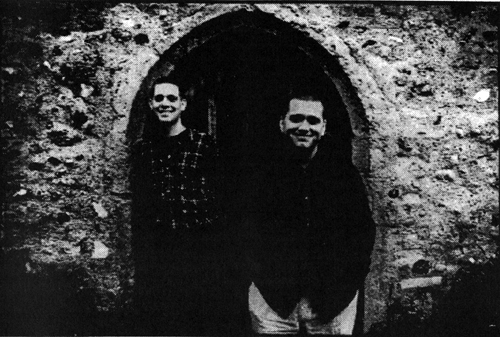
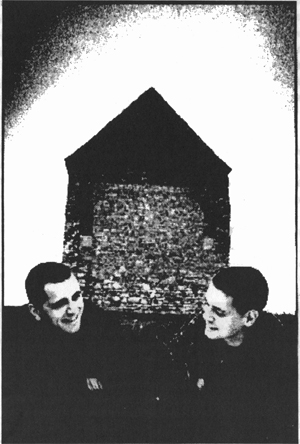
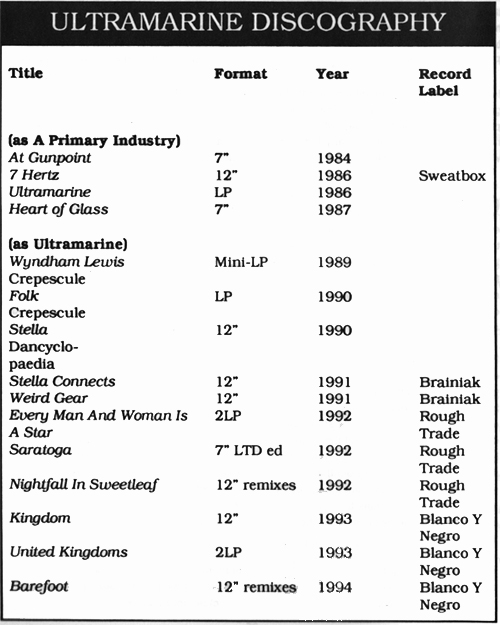
Ultramarine have a confusing pedigree. Whilst their reference points may be Ayers, Wyatt, Caravan and so on, their roots are really in Eighties post-industrial music: Cabaret Voltaire or 23 Skidoo, whilst their current standpoint reflects the dancey, ambient auto-rhythms of today. That' s probably where their main audience lies, but their unusual use of acoustic sounds allied to the electronics of today, means that Ultramarine have an audience all of their own. Ultramarine are Paul Hammond and Ian Cooper, two Essex exiles now living in New Cross, London, augmented by other musicians when and where they see fit. Their roles were initially more traditional: bass, keyboards, guitars, in firstly A Primary Industry, a band which started out in 1982, released several 12" singles on Sweatbox Records, plus an album entitled 'Ultramarine'. Paul: "It wasn't really taken that seriously - we never did any tours or there were only sporadic gigs."
|
|
Ian: "We were still at school and then had our own jobs, so it was basically fitting it in whenever we could, weekends and things like that and Ultramarine started a year after A Primary Industry with basically the same kind of people involved and still very much weekends ... we never had any money to do anything and then we were signed then to Crepescule (?) at the beginning of Ultramarine - we had a 12" EP and then our
first album 'Folk'."
'Folk' had a very Eighties, Factory feel to It: with buzz-saw guitar, funky bass, female vocals, but also hints of future Ultramarine trademarks: Paul: "I think that with 'Folk' there are distinct parallels with that and what we're doing now. The basic blend is quite similar. I think we're doing it in a different way
because we're using the technology. That was written and recorded as a band. But if you listen to the first track on that I mean there's no drums, just weird percussion and accordions and clarinets. It's got a very similar approach in a way, and there is minimal sampling and a few synth samples."
And yet 'Folk' is now almost a 'lost' album: Ultramarine no longer record in a band format, most of the other musicians are no longer involved and none of the material has survived within the live set. Ian: "We didn't play at that time live. We only started live quite a while after 'Every Man And Woman Is A Star' was released. We did a mere handful of gigs which was just the two of us running the computer live, having bits of synth and guitar played over the top, but we didn't really enjoy that, so that's when we recruited further members and expanded the sound to do full justice to the songs, because there was always a live element on the record."
It was really 'Every Man And Woman Is A Star' that broke the band. 'Folk' had been recorded over in Belgium (where Paul was working), and here it was that the band's next album began to take shape. Now a duo, the new
Ultramarine was to rely heavily on sampling technology, as well as taking on board many of the elements of the burgeoning house scene. This was crucial: with no prospect of their present label, Crepescule, releasing the already-recorded album, Ultramarine attracted interest first from the club label Brainiak, and finally from Rough Trade. Ian: "It was May 1992 we actually signed to Blanco Y Negro (a subsidiary of Rough Trade) with a recording contract to EMI on the publishing side and that enabled us to give up our full-time jobs. From then on it's been quite a serious concern, and we've been able to spend as much time on it as we want. So it hasn't suffered in any way." The Rough Trade deal also enabled Ultramarine to release the double album version of 'Every Man And Woman Is A Star' that had been put in jeopardy by the various record label problems.
The finished product proved to be a landmark. Interest in the ambient house scene was starting to snowball, and 'Every Man And Woman Is A Star* nestled within it quite happily, whilst serving notice that here was a band with much more to offer than most. The dub, trance and house rhythms generated by the band underpin the album, but the curious folk feel was maintained by use of acoustic instruments, whilst Ian and Paul were further exploring the possibilities of the sampler. This seemed to work in two ways: both in creating the mood for the whole album, and by splicing in recognisable snippets in a totally new context. Ian explains: "By that time we had our own sampler and we were using that at home, buying a lot of second hand records, using a lot of those acoustic sounds - the American stuff which came across was through getting dirt cheap albums
and liking certain sounds, but there was a lot of melodic west coast rock stuff that we picked up from second hand-records. We were listening to a lot more stuff through wanting to sample things. We had no preconceptions about any kind of music. We were listening to a huge amount of terrible stuff but unearthing some stuff that we genuinely liked."
 |
But what of the obvious reference points, such as Robert Wyatt's vocals sampled on 'Lights In My Brain', (or 'Saratoga', which featured a snatch of Didier Malherbe from Gong's 'Flute Salad')? Ian: "I think that a lot of the stuff on 'Every Man And Woman Is A Star' was stuff that we did genuinely like. It wasn't purely from the point of view of being a great sample - they were tracks that we were enjoying listening to - it wasn't wholly detached. We did genuinely love a lot of that American soft rock - it seemed to fit with the time somehow." I alarmed the band by identifying other samples such as the bird sounds from Yes' 'Close To The Edge' (Ian: "No-one's ever spotted that! Or no-one deigned to admit that they know the original source!") but was flummoxed by the scat Wyatt sample which appears on 'Saratoga', which was released as a single. It turns out to be from the Peel Sessions version of 'Esther's Nose Job'. ("You've got to know your Canterbury to keep up on us!"). These samples are an obvious hook-in for fans of this genre of music, reveal the band's influences and hopefully turn more people on to their original sources. But that's only part of the story, since the crucial aspect is the end result in terms of the music. In the case of 'Lights In My Brain', Ultramarine had come up with an unlikely club anthem.
"I don't want to make a big thing about the sampler but it is our kind of chief instrument", explains Paul, "although less and less we sample huge chunks of things -we do it very rarely now - more as a mean of creating sounds really. Just because that is our main instrument and you put into it what you like. It's not like we're sitting there with acoustic guitars or whatever and so it's very obvious in our music what we listen to and what we like, I suppose." The other impact of 'Lights In My Brain' was to show exactly how well the Wyatt voice fitted in with the Ultramarine sound. The next stage was clearly to approach him. Therein lies the story of 'United Kingdoms':
We had a specific idea for what to be our first release for Blanco", says Paul, "which was to be an EP. It was sparked off by hearing 'John Barleycorn' by Traffic - it was their version of an old traditional ballad, and we heard it on the car radio ..." Ian: .... driving from Deya to Valenca ...
through an olive vineyard!" What, Deya, seat in Mallorca over the years for musicians such as Lady June, Kevin Ayers, Daevid Allen, the Sinclairs and so on? It sounds almost like a pilgrimage.
Ian: "Just after we'd signed the deal and we realised that we were going to have at least a year doing music and we spent the grand total of about 300 quid on a holiday for the two of us and just went round Mallorca!
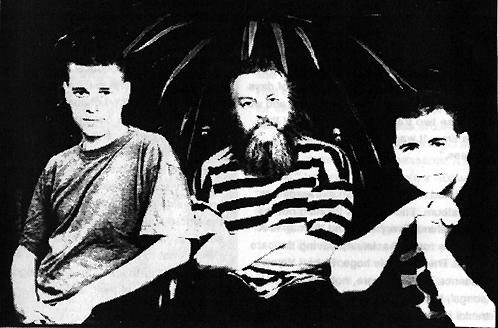
Paul Hammond, Robert Wyatt, Ian Cooper |
 |
"We were going to do an EP of folk songs with our music and thought that Robert would be the ideal vocalist to do it and so we put this idea to him and that just turned into the album really. And we sent him demos - three or four instrumental demos and a couple of sets of lyrics that we'd dug out from this library.
"We pretty much left it up to him to see what vocal lines he could fit to what tracks and he would send back a cassette with suggestions of how certain lyrics might be sung and then we whittled it down to a two songs: 'Happy Land' and 'Kingdom'. And then we spent quite simply a couple of days up in the studios near where he lives and we did those two tracks and the scats at the same time. It was a very easy smooth process."
'United Kingdoms' is an extraordinary album. The samples fleshing out the sound behind 'Every Man And Woman Is A Star' now took a backseat, leaving the bare bones. The impact is huge. Robert Wyatt's presence is everywhere, not just on the two 'songs', but scat-singing on highly impressive tracks such as 'The Badger', 'Dizzy Fox' and 'Urf'. There's also the band's spacey keyboard cover of the Matching Mole track 'Instant Kitten' (Paul has a postcard on his wall from Robert congratulating him on the Ultramarine version). But ultimately Ultramarine's triumph is in going even beyond this - they have taken the Wyatt voice, used it to perfection within their own framework, and then crafted some equally impressive tracks on their own ('English Heritage' bears witness to this). It's an astonishingly coherent project. I put it to the band that their own music on 'United Kingdoms' was veering towards Wyatt's own instrumentation throughout the Eighties, with the same sparse drums and stark keyboards - the same minimalist approach which had worked so well on the Robert Wyatt oddity 'Pigs'.
Paul: That feel was very much an influence on 'United Kingdoms' - we did consciously go for that sort of rough organ sound - it was very engrained in the whole album. And I think for us the whole point of that album - the general theme of it - it had a very specific theme but a vague political thing - it was meant to be pastoral in the very broad sense - it was meant to kind of conjure up images of England, be they good or bad, partly through the two vocal tracks and just through the whole imagery of the music. The lyrics tied in with the whole themes of people every summer being chased round the countryside by the police and people digging the whole country up to build a motorway -so it was just tied in with those general things - not to make specific points about it but just trying to imply these through the various aspects of the music.
"And Robert Wyatt is like the ultimate English voice - you can hear its accent -there's no hiding the sense that it is a folk voice ultimately."
Both songs evoke images of an England ot entirely in keeping with Blake's 'green and pleasant land', Wyatt's voice of melancholy adding the ultimate irony to 'Happy Land'. So where did these 19th century lyrics originate from? There's a folk library in North London that we went to", Paul explains, "and we just leafed through books. We wanted something with some sort of edge to it and there were a few possibilities and two which were the ones we used." Robert Wyatt has become renowned for entwining his music with protest - presumably this was part of the plan? "Exactly", continues Paul, "that's exactly what he's done in the past. He's drawn on a lot of folk music in the past but it's all been folk music from other cultures. There's nothing that I can think of that's been specifically English." Ian: "Yeah - it's always been Chilean or Spanish..." Paul: "So it was quite interesting for us to kind of drag him back to to his own backyard...." Ian: ... "to acknowledge the existence of a protest culture within England!..." Paul:"... which I think has been ignored. There's a great fear in the English of acknowledging their own past - they're embarrassed about the sort of period in the past and so on."
Ian continues: "I must add that they weren't easily dug up these things! We did spend a few very tortuous afternoons looking through collections of folk songs and stuff. This was at the English Folk Dance and Song Society in Regents Park. Most of it was terrible! And after looking through countless books there were only about 3 possibilities that we could find. Most of it isn't preserved."
|
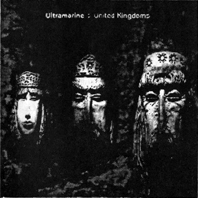
United Kingdoms
|
'Kingdom' and 'Happy Land' were both released as singles from the 'United Kingdoms' album, the former adding an extra Ultramarine track 'Goldcrest' using further Wyatt scats. Both singles were accompanied by videos. 'Kingdom' memorably involved Robert Wyatt in the guise of King Arthur, one of three figures depicted on the album cover, and the sole figure on the single. Ian explains the link: "All these things came together in our heads with the cover of the album and the single - we obviously had a subconscious connection with Robert's beard and things like that) It didn't really take a vast leap from there..." Paul sets the scene for the video. "We filmed some of it in his back garden - most of it was around that area of Lincolnshire. The whole band are dressed up as mediaeval peasants! It's quite surreal." Ian goes on: There's a Guinevere type figure who's dancing around with candles alight in her hair, dancing around in the undergrowth and leading us on a merry dance! There's banners, and funny instruments - it is very amusing! And it was a great day doing it - incredibly hot. And it was great dressing Robert up and he was really enjoying it himself, because he said that he didn't want to just lip-sync it so we ended up devising all these scrolls with the lyrics written out that he would look through. And there was all of this fruit mounted up on the table tops and it really had a strong Qreenaway overtones - a Drowning by Numbers vibe.
"... I remember we had done all our stuff. We just had those photos to do in the back garden with him and we had gone off to have a drink whilst Robert was sorted out and we went back to see the last filming and there was this hut at the end of Robert's garden. There was this bald -headed guy with this quill actually writing out these scrolls with Robert in the background."
Paul adds: "I remember looking through and seeing it - it was absolutely incredible. He was sitting at this huge table laden with all this stuff
and he was wearing this cloak and crown with this pheasant's wing sticking out of it. he looked amazing - this great grey beard." All in all, a
fruitful relationship - was there more in the pipeline? Paul: "Hopefully, yeah. We've not got anything in mind, but yeah, we'd always
like to do something with him - he's so good to work with."
Study the sonic landscape of 'United Kingdoms' and the other thing that strikes you is the sax, flute and clarinet work. A familiar Ultramarine sound, admittedly, but for this release more prominent, more sophisticated and adding a second solo sound alongside the Wyatt scats, notably on flute on the memorable 'Dizzy Fox'. The identity of the musician? None other than Jimmy Hastings, 'fifth member of Caravan', classical musician and sessioneer extraordinaire. Jimmy has also been playing live with Ultramarine for some time, and given the band's more recent collaborations with fellow-saxophonist Lol Coxhill, I asked Paul how such projects came about.
|
"It's just through being aware of who they were and how they played and so on. They're just working musicians like anyone else so you just ring them and ask them to do it and they'll do it. If you can afford it it's no problem at all." But what do musicians, in particular Jimmy Hastings, think of the music? "Well, I don't know - very passive in a way. He's an old jazzer really - he's not an old hippy - he's not into that sort of stuff. I would imagine he's always enjoyed playing with Caravan and related groups probably because he's given a lot of freedom. I mean, we just give him carte blanche really. We just say this is where we want you to "play and we just let him improvise really, which is far the best way of using those people because they have such an incredible musical knowledge. To tell them to do something would be restricting their musical flow really. We've always found it's best to let them go really.
"Lol's more sort of into us..."
It's unlikely that even he could top Jimmy Hastings' performances on 'United Kingdoms', but Lol Coxhill, left-field jazzer, busker and undoubted stage presence seems to fit the Ultramarine bill perfectly. Over the last year he has collaborated with musicians in the dance idiom both live (witness his set with Mixmaster Morris as support to Ultramarine in March this year) and on record with Pat Thomas. But, as Ian pointed out, his association with Ultramarine may well develop into more: "We did some demos with him down at EMI studios - the publishers gave us some free studio time, just to see how his style of playing would work on the songs that we're writing at the moment for the next single. So there's been nothing formalised yet - there are bits and pieces that work really well, so in one way or another there will be bits of his playing on the next record." It was also revealed to me that they'd like to incorporate Lol as a permanent member of the band, although the feasibility of this is obviously restricted by his more regular jazz bookings. However, the London Astoria gig, which saw Ultramarine take to the stage with extra live bass, guitar, keyboards, drums and sax/flute, as well as the Morris/Coxhill collaboration, shows that there is a fervent desire there to experiment in the live arena as well as the studio.
"It does seem to me that people are more open at the moment", points out Paul, "particularly the kind of audiences associated with the more interesting dance/electronic type stuff. There's a lot of stuff crossing over at the moment. It seems such a good time to build on that. The whole live scene has been so sort of stagnant and difficult to alter in any way for years. People by and large just want to go and see ... they don't give a shit about the support - they just want to go and have a drink and see the main band so I think any attempt to break out of that is a good thing. We felt that at that gig that the audience were really up for it."
Ian chips in: "I don't think people would have come along anyway if they'd been frightened of the sound of a saxophone - there's a good chance that the majority of them would have known that we used a sax player through having seen us. So Lol certainly had a good platform."
"You've got to shove it down people's throats to an extent!" continues Paul. "It's the great fashion at the moment for two blokes to be sitting down at a computer and anything live gets slightly sneered at. We've always had bad live reviews to be honest - the press, or the tabloid press - it
doesn't really fit in with what is meant to be happening at the moment, so having things like Lol on works well musically, but also winds a few people up, which is good."
I thought it would be a good idea at this I point to ask the duo about the processes involved in putting their music together -and how that would translate into live performances. I put it to them that your average Facelift reader would normally come across a band of, say, four musicians using technology as a secondary source of material, and approaching studio work in much the same way as live material. That's a generalisation, of course, but how do Ultramarine work, and how do they differ from your average techno/house band?
"Our actual working method is quite broken up in a way", explains Ian. "We take things to a certain level at home with the synth modules and samples and drum machines, building up basic parts of the track. Then we take it into the studio and have live playing over the top of that and take that home again with all the bits of live playing on DAT. Then we rig up the sampler and put on an arrangement and then leave it on the right place on the tape and go back again to mix.
There are various stages - so we are half way between the traditional rock method of putting things out in the studio and the now traditional method of doing all it in your bedroom! We are in the middle and we are getting the best out of both worlds - we aren't shutting any doors."
Paul runs through the live format: "Technically, what we do is have a look at the whole programme side of it and adapt whatever the track is to how we think it would best suit live. It might be losing a lot of stuff from the original because a lot of that subtlety is not relevant live. Quite often we strip a lot of stuff out and maybe look at the whole - because I'm playing bass as well live - we'll look at the whole bass side of the programs and the percussive side bearing in mind there's going to be live percussion anyway. Quite often we'll throw in things which aren't in the original - take things from remixes and so on. So that stuff that's in my room we take all that live with us - we've got all those modules and samplers being run with live sequencers which are mixed through small mixing desks on stage. At the moment all that stuff is arranged, rather than someone bringing it in and out.
"We are thinking of changing that to an extent so there is a bit more improvisation. And that's a job in itself even though it's arranged. Mixing all that and dubbing it up - the shape changes every night anyway, depending on the audience. And then there are a couple of analogue synths which require various sort of tweakings as we go along. Live we try and use bass, a keyboard player who uses a Hammond which he plays all the organ lines on, and then the sax and flute and so on."
Ian: "Up to now we have only been able to have things arranged in advance because the arrangements have been so tight. Because if you have, say, five things dropping out at the end of eight bars and seven different things coming in you haven't got enough fingers to do that!"
Another unfamiliar area might be that of remixes. Ultramarine have put out two EPs of remixes, each one corresponding to material plucked from the last two albums. Here, for say Wyatt completists, the distinctions get hazy. Does the Spooky version of 'Lights In My Brain', complete with remixed Robert sample make it into the Wyatt discography? And, if not, what about the Fila Brazillia remix of 'Urf (which had original Robert Wyatt scats) from 'United Kingdoms'?
Paul: "What our policy has been for these two EPs has been to just pick people who we like and pick something from the album and let them do exactly what they want with it! The only input that we've had is editing and we have edited a number of them, without exception, because the stuff we've got back goes on too long, or they could actually be more listenable if they were chopped around a bit. With 'Panther' we totally put together from various things - we did a huge job on that whereas on 'Badger' we might have just chopped a little bit out of that just to trim it down a bit. Which is quite nice in a way because at least you get your hands on it and feel as though you're moulding it a bit. They usually tend to go on a bit too long!"
|
Ian: "We've been impressed by the remixes that we've had done - we have genuinely loved them - it's not so much a commercial thing for us for us to have remixes done: our remixes aren't backing a single - they tend to be a selection of different tracks to make up a separate release in itself. So it's not like we've had club versions done. The remixes use people whose music we admire and do interesting jobs and they stand up on their own. And we have fed off the ideas that people have put into those remixes." So far the remixes have included Richard H Kirk, formerly involved with Cabaret Voltaire, and squeaky clean-sounding trance merchants Spooky (who toured with Ultramarine in September last year).
That then maybe is the club side of Ultramarine manifesting itself. But again it's the flexibility of the Ultramarine approach that makes so many things possible. They've cultivated a whole new audience through regular tours with Bjork, yet they've also profited through a loose association with the Megadog set-up. Megadog have been responsible for packaging all the best trance/ambient house acts - extending the London club base to a monthly touring network and a label, Planet Dog. "We've been very lucky in that we've been involved with the Megadog thing, which we've done very well out from", says Paul. And yet they're not quite as straight ahead as many Megadog acts. In fact, at times when playing live, the extra instrumentation almost puts them in the acid jazz category. Paul: "I think we sort of glaze over as soon as labels start appearing. It's a mixture of lots of different things and as soon as we start to think of it in relation to other kinds of music - contemporary music - various hybrid forms of techno - it's just not worth bothering. So what we're hoping is that we're not going to have to bother with those labels. It's music and music is from so many different cultures... blah blah blah. And it's a shared sound so as soon as you start to put these names on it you're starting to build walls..."
And this also leaves a lot of options open. When we spoke, the band's two imminent commitments were in vastly different fields. One was a projected single with Kevin Ayers, a tasty reworking of 'Hymn' from the 'Banamour' album ("The cassette's winging its way to him as we speak"). The second was a projected 3-day festival in Moscow, featuring the cream of British experimental club culture: The Orb's Alex Patterson, Banco de Gala, The Aphex Twin, Seefeel and so on. By all accounts Russia's current crises rendered these events somewhat farcical: NME captured Ultramarine both posing with a bust of Lenin and liberating a sofa from its 17th floor hotel window! At the time of the interview, Ian was dubious that they'd even make the trip because of restrictions on the size of the live band, but, luckily, as it turned out, they'd recruited a new drummer just in case: "We've got another drummer, but we've never actually played with him yet. because of this Moscow thing we had to get visas really quickly and we had no time to audition anybody. We just met somebody who we really got on with, who incidentally was well up on Canterbury, so he can't be all bad!" Paul adds: "He said his influence was Pip Pyle! He looks like a younger Kevin Ayers as well so he'll fit in quite nicely!"
All these Canterbury references led me to finally ask Ultramarine what elements of the Canterbury scene interested them most, and how those influences translated themselves into their music.
Paul: "I think it's the whole idea of playful experimentation that comes from it - the whole atmosphere rather than any specific thing musically."
Ian: "I don't think we've ever reduced it down to one or two influences. I think we've always been amazed, surprised and thankful that it is as multi-faceted as it is - you have that pop element with Caravan with the incredible melodies, you have that simple and so direct and tightly constructed songs by people like Kevin Ayers and you have the out on a limb emotional nightmares/whatever Robert Wyatt does. You have that scope..."
Paul: "...and even things like Gong. And all of it is done with such freedom musically. He wrote so many songs which could be, which are effectively great pop songs but they are all done with a looseness and lack of concern for any pop production - musically they're incredible and very adventurous - probably an era where the whole business side of things was irrelevant.
"From what we've experienced from I meeting some of the people concerned, they are (were) very naive in a business sense and I'm sure that's an indication of why they were so free-minded musically - there wasn't that concern with things being radio length and having the right vocal sound and all this sort of crap. I mean they didn't give a toss -they did exactly what they wanted and it wasn't a concern, the financial side of it, which really does restrict so many people nowadays... including ourselves."
Many people would have problems seeing musical links between the genesis of the progressive era, in the Sixties, and the shift away from recognisable instrumentation and composition that has underpinned much of the music in the Nineties. Paul has definite views on this subject: "I wonder how different it is though? I mean you take someone like the Soft Machine and look at what they had to play with on their first couple of records. If they existed now what would they be doing now? I mean they wouldn't just be using organs and drum kits, would they? They'd be using samplers and all sorts of stuff. They were using the studio on the second album, tape loops and stuff. So it is easy to think now seeing them as a 'real musicians' band in a traditional sense of it but in the true context of what was happening at the time they were very experimental and were using studios and a limited amount of experimentation that they could get away with. So I think if they had existed in the Eighties they would probably have sounded like 23 Skidoo or A Certain Ratio or something like that."
Ian: "I think it's a sentimental notion that a group can remain static and we can transplant it to a different decade, but if they had made the same music in the early Eighties I would have probably been interested."
On the other hand ... "In a way", says Ian, it's a shame that Canterbury or whatever that that's been such a revelation to us, that we've managed to get so many ideas of that sort of experimentation and playfulness from 20/25 years ago - there should be more be more things going on now that we can more easily relate to - to get those more adventurous and inventive ideas from."
Paul: "Having said that, the more interesting electronic stuff now - it's no coincidence that you're interested in that and in stuff that happened 25 years ago. there is an element of that in the more interesting stuff nowadays. There is a freedom and there isn't really a set agenda because it's so new, a lot of it. So I think you can see from that that we're interested in these seemingly totally separate things but I think that when it comes down to the basic intention behind it they are all linked."
That statement might well ruffle a few feathers, but I had to agree that there is an openness about current music, and a willingness to absorb any number of influences that makes it an exciting era. And I put it to Paul and Ian that, although all three of us were in our nappies in the late Sixties, surely today's musical open-mindedness, the multi-media club 'happenings', even the overt drug culture were echoes of that era.
"The Canterbury scene was one of the more interesting, artistically valid products of that", offers Paul, "and similarly there is a lot of interesting stuff at the moment. There's a lot of crap, but I'm sure there was a lot of crap then..." Ian goes on: "I'm sure those Middle Earth gigs were pretty kind of heady affairs. I think there are connections there and a lot of parallels. I think that people catching it first time round would have picked up on combining and blending of different styles and the crazy sounds. That is no different really to the more adventurous sounds now."
And what of the obvious musical differences in style between now and then? What about the accusations of a lack of musical proficiency levelled at techno-based outfits? Paul: "One of the key points if you compared the electronic or dance stuff nowadays to that scene in the late Sixties and early seventies and the Canterbury scene, you could say the thing missing now is the musicality. But there's been so much music between then and now that in a way there's little point in exploring things in a traditional music way - it's more about ideas and sounds now so it's not really relevant. Obviously they are better players and are more involved on a purely musical level but it's not really all that relevant at this stage..." (Ian: "Do we need any more guitar heroes? The Seventies and Eighties were full of them.") "... and also through things like samplers. I think a lot more people are getting clued into textures and quality of sounds. It's a different kind of thing. It's not so much about notes - it's more about sounds."
Ian has the final word: "You could say about Robert Wyatt's stuff especially - certainly •Rock Bottom' - it's the space, it's the textures ... it's the shapes. It's the obtuse things you can't pin down - it's the whole work - it's the place it takes you.
"It all comes back to Robert Wyatt...!"
 |



 Ultramarine - Lights In Their Brains - Facelift - N° 13 - August 1994