| |
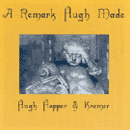
A Remark Hugh Made
1995
Hugh Hopper & Kramer
|
|
|
| |
FACELIFT - Issue Fourteen - June 1995
Hopper/Kramer
A Remark Hugh Made
Shimmy Disc 076
|
|
|

|
Hugh Hopper rocks! Well, not exactly, but it did strike me on listening through this album that Hugh hasn't really done many non-jazz albums in the last 25 years. Not that any of his hybrid projects really allow any easy classification. But in teaming up with Kramer, US eccentric musician and father of the Shimmy Disc label, he's really dabbling in a pastiche of noise, psychedelic pop, and general quirk (sorry, Martin) not heard from the Hopper bass since the Sixties.
You couldn't really say that this album is anything like the Kramer/Daevid Allen CD either. Songs have been replaced by rambling instrumentals which revolve around very simple themes, but often take time out to explore further. Kramer provides most of the basic sound: his legendary 'cheap organ' is just one of a vast array of sounds encompassing mellotrons, slide guitars and percussion.
A total shock was hearing Robert Wyatt's voice on track one. 'Free Will And Testament' is a simple theme, but Wyatt has always thrived on the starkness of his images. With lyrics penned by the singer, 'Free Will and Testament' is an inward-looking, rather pessimistic outlook on life.
I'd been more in the know about the inclusion of some of Gary Windo's work - the late sax player's sounds have been heard in the context of a Hugh Hopper album before, adding his guttural, atonal sounds to otherwise fairly melodic structures. It's a tried and tested formula - but what's surprising is quite how well these samples, dug out of the archives, fit in. On the astonishing 'John Milton Is Dead', powered by bass and Bill Bacon's pounding drums, Windo's first involvement is a bloodcurdling scream - he follows it with vintage sax work. Scrabbling around like a frustrated turkey, the sounds he coaxes approach the spinechilling impact of Hugh's '1984' piece 'Minipax 1'. The Twelve Chairs' explores a similar theme, this time with screaming guitar.
Just as good is 'All In My Head' which just about qualifies as a 'song' - funereal drums and wailing guitar usher in a vocal passage reminiscent of some of Robert Wyatt's most moving solo work. On more than one occasion tracks reminded me of the feel that 'Rock Bottom' had, and it goes back to the idea of playing simple themes and using instrumentation and effects to take it one stage further. I'm too far down the road to think of this sort of music as 'strange' any more, but it's certainly not normal listening. 'Lenny Bruce Sings' has that Wyatt-esque piano noodling, wonderful warm bass with a hint of menace, and a bizarre series of vocal samples. A disturbing mix.
Two songs are included which you should recognise. 'Sliding Dogs' from Isotope days is included, with chattering drums from Bill Bacon, fuzzbass from Hugh Hopper and a most appropriate guitar diversion from Kramer. This and the Hugh Hopper number 'Superthunderstingercar' are still the closest to contemporary Hopper styles of composition we get. In an extremely odd twist, the other recognisable song is the Beatles' 'We Can Work It Out, notable for slide guitar.
Hugh Hopper doing a Beatles cover? I suppose it's no odder than Whitney Houston covering a Hugh Hopper song.
|


